
What Are the Differences? Things You Must Know Before Learning Taiwanese Mandarin
Is there a difference between Taiwanese Mandarin and Standard Mandarin?

In a word – yes!
There is definitely a difference (or several) between Taiwanese Mandarin and Standard Mandarin.
Every language can be varied when being used or spoken in different regions.
The factors which influence and cause the variations may include geography, weather, culture, history, policy, generation, social composition, local dialects, etc.
Different places where Mandarin is spoken, tend to have some differences in vocabulary, tone, writing system and more, think of how different it must be in different provinces of China, Hong Kong, Singapore etc.
Taiwanese Mandarin || What’s the Difference between Mandarin and Chinese?
Taiwanese Mandarin || Do People in Taiwan Speak Mandarin Differently?
Taiwanese Mandarin || The Interest in Learning Taiwanese Mandarin
Taiwanese Mandarin || Pronunciation
Taiwanese Mandarin || Grammar
Taiwanese Mandarin || Which Words Are Different in Taipei?
Taiwanese Mandarin || Tones
Taiwanese Mandarin || Experience Sharing
Taiwanese Mandarin || Is It Worth Learning Mandarin in Taipei?
Taiwanese Mandarin || Next Steps // Keep Learning Mandarin
Taiwanese Mandarin || FAQs
Want to see what it’s like learning Chinese out and about in Taiwan?
Check this out…

What’s the Difference between Mandarin and Chinese?
OK before we get into Taiwanese Mandarin, a hugely common question we get asked is…
“What is the difference between Chinese and Mandarin?”
So let’s set the record straight with that first and foremost…
Chinese

The term “Chinese” refers to a common language spoken in China, but actually, it is a linguistic group (part of the Sino-Tibetan linguistic family) that encompasses hundreds of local language varieties, generally classified into seven main regional languages/dialects 方言: Mandarin, Cantonese, Hakka, Wu, Min, Xiang, and Gan, each one including its own sub-dialects.
Therefore, when we talk about the Chinese language, we should consider there is no such a unique language as “Chinese”, but there are instead many varieties (Chinese languages), among which the most common one is Mandarin.
Mandarin Chinese
Mandarin Chinese: 官话 (guānhuà), literally the “speech of officials”, is the native language of two-thirds of the population.
Mandarin encompasses a group of related varieties of Chinese spoken across most of northern and southwestern China, and it includes the Beijing dialect, which is the basis of Standard Mandarin or Standard Chinese.
Modern Standard Mandarin Chinese is the official spoken language of the People’s Republic of China (PRC), the official language of the Republic of China (ROC, Taiwan), and one of the 4 official languages of the Republic of Singapore.
In Beijing, people call modern standard Mandarin 普通话 (pǔtōnghuà), literally “common speech”, while in Taipei you’ll hear 國語 (guóyǔ), literally “national language”, or 華語 (huáyǔ), “Hua (Chinese) language”. 華語 is the word you’ll meet most as a learner: Mandarin classes in Taipei are 華語課 (huáyǔ kè), and the TOCFL exam’s Chinese name is 華語文能力測驗.
So to sum it up quickly. Chinese refers to a large group of dialects, Mandarin being one of (the most popular by a comfortable distance) those dialects.
Got it? Let’s move on…
Do People in Taiwan Speak Mandarin Differently?
What language does Taiwan speak?
Apart from the fact that people in Taiwan write with Traditional Chinese characters rather than Simplified ones, there are still several differences between Taiwanese Mandarin and the Mandarin you’d hear in Beijing.
The pronunciation guide is different too. Children in Taiwan first learn sounds with Zhuyin (注音符號 zhùyīn fúhào), a set of 37 phonetic symbols nicknamed bopomofo after its first four letters, ㄅㄆㄇㄈ.
You’ll see Zhuyin printed beside characters in children’s books and dictionaries, and many people in Taipei type on their phones with a Zhuyin keyboard.
Pinyin is still very much around. Hanyu Pinyin has been the official romanisation in Taiwan since 1 January 2009, and Taipei uses it on street signs, although you’ll spot older spellings in other cities and in many personal names.
You can happily study with Pinyin, and picking up Zhuyin later is a great bonus if you want to read children’s books and type like a local.
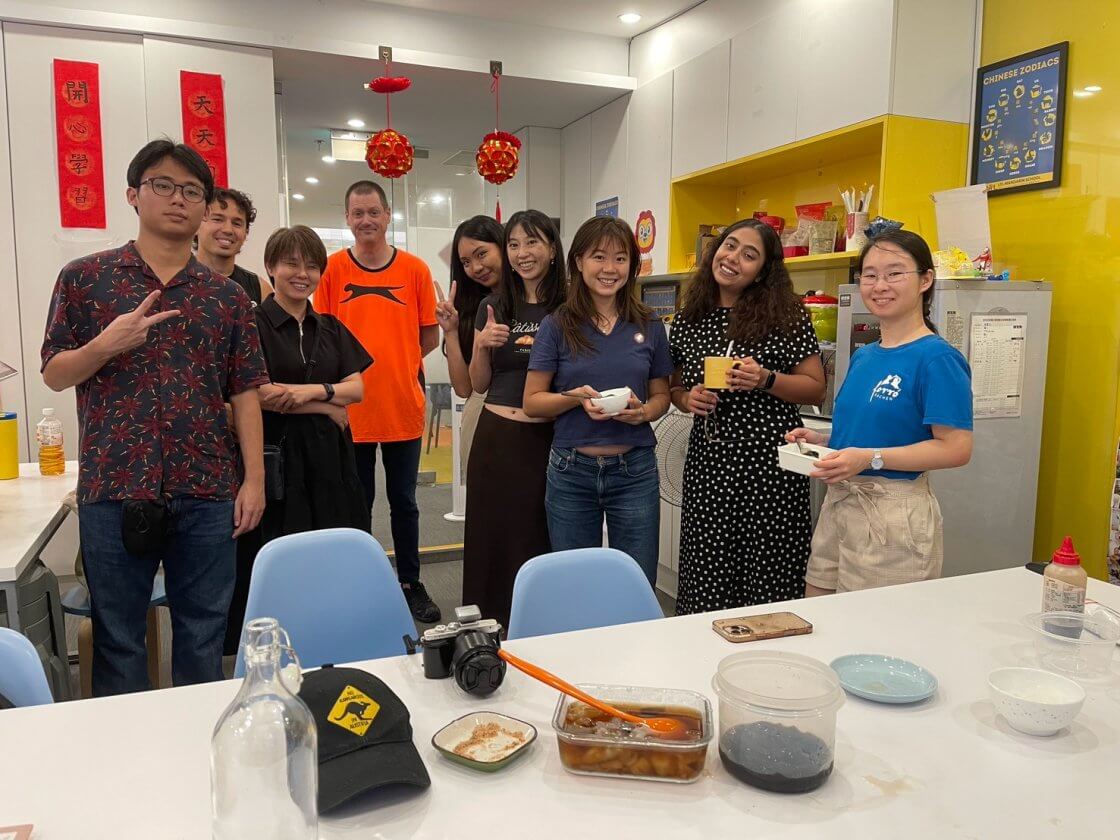
Many people think that China is the only destination for them to learn Mandarin since it seems to stand for the “standard”.
However, it doesn’t mean that what you’ll learn in Taiwan won’t meet the specification. The situation is similar to the relationship between British English, American English and Australian English or between Spanish spoken in Spain and in Latin America.
Aside from Mandarin Chinese, which is the official language and spoken generally by everyone, Taiwan also uses various other languages, such as Taiwanese Hokkien and Hakka.
Taiwanese Hokkien (台語 Táiyǔ) is what most people mean when they say “Taiwanese”. It belongs to the Min branch of Chinese, not the Mandarin branch, so someone who speaks only Mandarin won’t follow a conversation in it.
Hokkien also has more tones than Mandarin, usually counted as seven or eight, and they shift constantly depending on the next word. That makes it a real challenge even for advanced Mandarin learners.
Hakka (客家話 kèjiāhuà) is another Chinese language with its own communities. Taiwan also has Indigenous Formosan languages such as Amis, Atayal and Paiwan, which are Austronesian and not related to Chinese at all.
All of this has shaped the Mandarin you’ll hear in Taipei. Mandarin became the language of schools in Taiwan from the late 1940s, so it grew up where many families spoke Hokkien or Hakka at home. Before that, Taiwan was under Japanese rule from 1895 to 1945, and a few Japanese words stuck around:
| Taiwanese Mandarin | Pinyin | Meaning | From Japanese |
|---|---|---|---|
| 便當 | biàndāng | lunch box | bentō |
| 歐巴桑 | ōubāsāng | older woman, auntie | obasan |
| 甜不辣 | tiánbùlà | fried fish cake | tenpura |
| 阿莎力 | āshālì | straightforward, generous | assari |
Did you know you can learn Taiwanese Hokkien with LTL?
The Interest in Learning Taiwanese Mandarin
Taiwanese dramas, variety shows and pop music have fans across the Mandarin-speaking world, so many people meet the Taipei accent on screen long before they visit. If you already watch Chinese TV programs, shows made in Taipei are one of the most enjoyable ways to tune your ear to the local sound.
TIP💡 Want to hear Mandarin the way people speak it in Taipei before you arrive? Start with these:
| Resource | What it is | Best for |
|---|---|---|
| TaiwanPlus Mandarin (YouTube) | Short video lessons on everyday situations | Hearing the Taipei accent with subtitles |
| Taiwanese dramas and variety shows | Series filmed in Taipei and other cities | Natural speed, slang and 有 + verb in real speech |
| MOE Concised Mandarin Dictionary (國語辭典簡編本) | Free online dictionary with Zhuyin, Pinyin and audio | Checking how a word is pronounced in Taipei |
| Pleco | Dictionary app that handles Traditional characters | Looking up words on signs and menus |
| HelloTalk or Tandem | Language exchange apps | Chatting with native speakers in Taipei |
| LTL on YouTube | Our own short Mandarin lessons | Quick tips between classes |
I personally didn’t realize it until many of the Chinese students that I met asked me, “Do I sound Taiwanese?”, or told me, “I am learning how Taiwanese speak Mandarin”.
Some learners even come all the way to Taiwan to study Mandarin in Taipei and pick up the local accent first-hand.
Later I am going to introduce some significant features of Taiwanese Mandarin which distinguish it from the Mandarin spoken on the Mainland. You will learn how to speak Mandarin like a Taiwanese local.
When interacting with Taiwanese, speaking Mandarin will make them impressed.
Nevertheless, speaking Mandarin with some local features from Taiwan will surprise them further and quickly bridge the gap between you and society, which will definitely bring you some advantages.
Taiwanese Mandarin – Pronunciation
Many Chinese people find that Taiwanese speak Mandarin more softly (which is nothing to do with volume) and the accent is very easy to distinguish. Nonetheless, how’s it possible to “speak softly”?
Weakening zh, ch, sh, r
In Mandarin, the consonants zh, ch, sh and r are retroflexes, which are big challenges for many learners.
To pronounce them, you are supposed to raise your tongue to touch the palate with the back of the tongue tip.
The air stream goes through the extremely narrow space at the exact moment when the tongue tip leaves the palate and causes affricates zh and ch.
However, if the tongue tip doesn’t leave and the air stream goes directly through the blade of tongue and the palate, it thus cause fricatives sh and r.
In Taiwanese Hokkien, the language most spoken in Taiwan apart from Mandarin, there are no such retroflex consonants. (Curious? You can even learn the local Hokkien dialect with us.)
Although people still pronounce them when speaking Mandarin, due to the influence of Taiwanese Hokkien, they don’t raise their tongues that much.
Perhaps it sounds a little abstract.
Let’s say, if we set a scale to evaluate the retroflex by measuring the tongue raising extent, and set Beijing Mandarin as 10, then Taiwanese Mandarin may fall in 6 or 7.
However, this doesn’t mean the Taipei zh, ch, sh and r are not retroflexes. Instead, it just sounds softer and doesn’t require that much effort to pronounce.
In even simpler terms, a Beijing zh sounds a little like the ‘j’ in ‘jerk’ said with the tongue curled back, while in Taipei it often drifts toward the ‘ds’ in ‘reads’, which is the Pinyin z sound. In the same way, ch slides toward c (the ‘ts’ in ‘cats’) and sh toward s, so 是 shì can come out close to sì.
The r sound is softer too, and you’ll almost never hear erhua (兒化 érhuà) in Taipei. In Beijing, people add an r to the end of many words, so ‘where’ is 哪兒 nǎr and ‘to have fun’ is 玩兒 wánr. In Taipei you’ll hear 哪裡 nǎlǐ and 玩 wán instead, which is good news if your tongue is still getting used to Mandarin’s r!

Inserting ‘U’ Vowel
When talking with Taiwanese, if you pay attention, it’s not hard to find that they tend to insert an additional vowel u between the consonant and the vowel o or eng.
For instance, they pronounce:
- 魔法 mófǎ (magic) as muófǎ
- 老婆 lǎopó (wife) as lǎopuó
- 玻璃 bōlí (glass) as buōlí
- 颱風 táifēng (typhoon) as táifōng
- 聯盟 liánméng (alliance) as liánmóng
The list goes on…
Replacing ‘eng’ with ‘en’
Another significant feature of Taiwanese mandarin is the transition from tongue root nasal eng to tongue tip nasal en, which can also be regarded as a weakening phenomenon since it makes the pronunciation sound less sharp and softer.
For example, you may hear people pronounce:
- 心情 xīnqíng (mood) as xīnqín
- 蜻蜓 qīngtíng (dragonfly) as qīntín
- 應該 yīnggāi (should) as yīngāi
- 聖誕節 shèngdàn jié (Christmas) as shèndàn jié
- 名字 míngzì (name) as mínzì
The list goes on!
BONUS || As well as these three features, you may find that people in Taipei speak quickly and smush words together. Get used to hearing something that sounds like ‘dengyiya’ for děng yíxià 等一下 (wait a moment)…!
You may also notice a couple of sound swaps, mostly from older speakers or people who grew up speaking Hokkien at home. f and h can blur, so 飛機 fēijī (plane) may sound like huījī, and n and l can merge, so 你 nǐ and 李 lǐ sound alike.
You don’t need to copy these, but knowing about them will save you some confusion at the night market.
Taiwanese Mandarin – Grammar
The influence of Taiwanese Hokkien can not only be found in the aspect of pronunciation, but also in grammar and sentence structures.
In the following, we are going to see one of the most typical sentence patterns in Taiwanese Mandarin.
「有」字句
有 yǒu means “have”, which is only used to describe the status of possession in Standard Mandarin.
Therefore, we know that 有 yǒu can only precede a noun. For instance:
我有一隻狗。Wǒ yǒu yì zhī gǒu.
(I have a dog.)
他的朋友有三百元。Tā de péngyǒu yǒu sānbǎi yuan.
(His friend has three hundred dollars.)
你有機會在這間公司工作。 Nǐ yǒu jīhuì zài zhè jiān gōngsī gōngzuò.
(You have the opportunity to work at this company.)
我對你有信心。Wǒ duì nǐ yǒu xìnxīn.
(I have confidence in you.)
However, under the influence of Taiwanese Hokkien, people even use 有 yǒu to convey that they have already done something or even to describe the emotional state.
In this case 有 yǒu can also precedes a verb or state verb. For example:
你有聽到聲音嗎? Nǐ yǒu tīngdào shēngyīn ma?
(Have you heard the sound?)
她有生氣嗎? Tā yǒu shēngqì ma?
(Has she gotten angry?)
你妹妹有吃飯嗎? Nǐ mèimei yǒu chīfàn ma?
(Has your younger sister eaten?)
他有沒有去過那家餐廳? Tā yǒu méiyǒu qùguò nà jiā cāntīng?
(Has he been to that restaurant?)
你有沒有想念我? Nǐ yǒu méiyǒu xiǎngniàn wǒ?
(Have you ever missed me?)
Although the usage of 有+Verb/ State verb is not correct according to Standard Mandarin, and your teacher will definitely tell you that it’s not allowed in classroom.
The truth is, everyone uses it sub-consciously and so regularly that you can hear it anytime and anywhere.
The 有 + verb pattern has become so commonplace that some Mandarin teachers even start to argue that maybe it will become standard someday.
Vocabulary // Which Words Are Different in Taipei?
Some words in mainland China and Taiwan are completely different. If you’ve learnt mandarin in China and move to Taiwan, or vice versa, you’ll definitely notice this straight away as some very common words are very different.
For example, a bicycle in Taipei isn’t a 自行车 zìxíngchē like in Beijing, it’s a 腳踏車 jiǎotàchē. If you’re ordering coffee in Starbucks and are really thirsty, you’ll want a 特大杯 tèdà bēi (Venti), not a 超大杯 chāodà bēi.
And if you want to take it out, ask for 外帶 wàidài, not 带走 dàizǒu. (Alternatively, if you’re staying to enjoy the free WiFi and aircon, tell them 內用 nèiyòng, lit. ‘use inside’.)
Here are more everyday words you’ll use in your first week in Taipei:
| Taipei | Pinyin | Meaning | Beijing | Pinyin |
|---|---|---|---|---|
| 計程車 | jìchéngchē | taxi | 出租车 | chūzūchē |
| 捷運 | jiéyùn | metro, MRT | 地铁 | dìtiě |
| 馬鈴薯 | mǎlíngshǔ | potato | 土豆 | tǔdòu |
| 鳳梨 | fènglí | pineapple | 菠萝 | bōluó |
| 軟體 | ruǎntǐ | software | 软件 | ruǎnjiàn |
| 影片 | yǐngpiàn | video | 视频 | shìpín |
| 早安 | zǎo ān | good morning | 早上好 | zǎoshang hǎo |
| 禮拜一 | lǐbài yī | Monday | 星期一 | xīngqī yī |
💡 Most people in either city will understand both words in a pair.
星期 is perfectly normal in Taipei too, but in everyday chat you’ll hear 禮拜 lǐbài just as often, and 早安 is the greeting you’ll get from your homestay family or the breakfast shop. For a longer list, see our side-by-side guide to Taipei and Beijing Mandarin.
Mixing Mandarin and Taiwanese Hokkien is a common phenomenon in Taiwan, although you may not feel so if you live in Taipei.
Nevertheless, you will agree with me if you live outside Taipei or travel to another city or county.
Furthermore, there’s a tendency that the further south you travel, the more frequently you will hear people speaking Taiwanese.
As a result, many words or terms can exclusively be found in Taiwanese Mandarin since they are directly borrowed or translated from Taiwanese.
For example, people call their grandparents 阿公 agōng (grandpa) and 阿嬤 amà (grandma) instead of 爺爺 yéye and 奶奶 nǎinai.
You may hear them say 一台車 yì tái chē (a car) and 一台電腦 yì tái diànnǎo (a computer) rather than 一部車 yí bù chē or 一輛車 yí liàng chē and 一部電腦 yí bù diànnǎo because in Taiwanese Hokkien the quantifier for cars and machines is “tâi”.
Moreover, people in China usually say 不客氣 bú kèqì or 沒事 méishì to express “You’re welcome” or “No problem” when receiving others’ gratitude.
Nonetheless, in Taiwan aside from 不客氣, you can also frequently hear them say 不會 búhuì.
Used this way, 不會 búhuì means neither “unable” nor “will not” since it’s translated from bē or bōe, which in Taiwanese means 不會 but is also used to reply to people’s appreciation.
💡 Watch out for words that look the same but land differently. In Taipei, 小姐 xiǎojiě is a perfectly polite way to call a waitress or shop assistant (“Miss”), while in Beijing it can carry an unwanted nightlife meaning, so people there tend to say 服务员 fúwùyuán or 美女 měinǚ instead.
And 酒店 jiǔdiàn, the everyday word for a hotel in Beijing, can also mean a hostess club in Taipei. When you’re booking a room here, ask for a 飯店 fàndiàn or 旅館 lǚguǎn.

Taiwanese Mandarin – Tones
As well as different choices in vocabulary, Mandarin in Taipei uses different tones for a few words too.
Of course, people will still understand you, and there aren’t so many differences. So don’t worry, you don’t have to learn the tones all over again!
Here are a few common words where the Taipei dictionary standard and the Beijing one differ:
| Word | Pinyin in Taipei | Meaning | Pinyin in Beijing |
|---|---|---|---|
| 星期 | xīngqí | week | xīngqī |
| 垃圾 | lèsè | rubbish | lājī |
| 危險 | wéixiǎn | dangerous | wēixiǎn |
| 企業 | qìyè | company, business | qǐyè |
Taipei speakers also use the neutral tone (輕聲 qīngshēng) much less. In Beijing, the second syllable of many words goes short and light, but in Taipei it usually keeps its full tone:
東西 (things) is dōngxi in Beijing and often dōngxī in Taipei, and 認識 (to know someone) is rènshi in Beijing and rènshì in Taipei.
Taiwanese Mandarin – Experience Sharing
Let me share two stories, which are my personal experience, to demonstrate how people can identify you by the accent or the way you speak Mandarin.
When I was little, my mother taught me at home instead of sending me to kindergarten.
In other words, the preschool education that I received was all from my mom.
I learned the pronunciation from her and from the audiobooks or teaching materials that she bought.
Later, when I entered elementary school, I surprisingly found that I spoke Mandarin differently from other kids.

Aunt Tiger || Taiwan Legend and Nursery Rhyme
The story of Aunt Tiger is one of the shared memories of many Taiwanese. They also recognise it as one of the most terrible nightmares of their childhood.
Many people even thought I was from China. However, after some years of “socialization”, I gradually acquired the so-called Taiwanese Mandarin accent and thus sub-consciously changed my accent to sound like the other students!
Many years later, I went to Europe to study a masters degrees. One day after solving a problem for a Chinese student in class, he said 謝謝 (Thank you) and I replied 不會.
He was very surprised and realized that I was in fact from Taiwan.
The same story happened again and again in my workplace where I had to deal with lots of Chinese clients.
After some conversation, they usually got curious about my origin by my accent. Some even directly recognized the fact that I am Taiwanese.
Is It Worth Learning Mandarin in Taipei?
The difference between Taiwanese Mandarin and Mainland Mandarin is just about the variation of a language, nothing to do with the question of which one is superior or inferior.
Besides, you don’t have to worry that you can’t learn Mandarin well in Taiwan.
It is also said that learning Spanish in Barcelona might not be a wise choice since people there speak a lot of Catalan too, which may cause confusion.
However, according to my personal and others’ experience, we not only learned Spanish well without a problem, but also acquired Catalan naturally in our daily lives.
Likewise, those Mandarin learners in Taiwan can also prove this to you as well because I’ve seen many.
After all, learning a new language is like gaining a new soul. Therefore, choosing Taiwan as your destination to learn Mandarin is the cleverest decision because it’s like killing two birds with one stone!
Those differences between Taiwanese Mandarin and Chinese Mandarin that I’ve just mentioned are merely the tip of the iceberg.
Next Steps // Keep Learning Mandarin
Want to kick-start your journey learning Mandarin online? No problem we have courses which can be tailored to you. Let’s get you started today!
Or if you want to go one better and come to Taiwan, check out what two of our students said about studying Chinese in Taiwan…

Taiwanese Mandarin FAQs
What’s the difference between Mandarin and Chinese?
Chinese refers to a large group of dialects, Mandarin being one of (the most popular by a comfortable distance) those dialects.
Does Taiwan use Simplified or Traditional Mandarin?
Taiwan uses Traditional Mandarin compared to the Mainland which uses Simplified. Traditional characters generally look more complex but actually some traditional and simplified characters are the same, or have very minor differences.
Discover more about the differences between Simplified and Traditional here.
Is learning Chinese in Taiwan different to learning Chinese in the Mainland?
The short answer is yes.
Every language can be varied when being used or spoken in different regions. Even in Mainland China, learning Chinese in Beijing, or Guangzhou would also be different given the fact each region has their own dialect. Either way, you’ll still be learning Mandarin.
Is Simplified Chinese understood in Taiwan?
Mostly yes, with some effort. Many characters are the same or similar in both systems, so readers in Taipei can usually work out Simplified text, but it isn’t what they grow up reading.
Everything you’ll see day to day in Taipei, from MRT signs to menus and forms, is written in Traditional characters. If you’re planning to study or live here, learning Traditional from the start will save you a lot of guesswork.
Do Mainlanders think Taiwanese sound very different?
Many Chinese people find that Taiwanese speak Mandarin more softly (which is nothing to do with volume) and the accent is very easy to distinguish. Taiwanese weaken certain sounds like Zh, Sh and Ch.
Those aforementioned consonants are called retroflexes. Let’s say, if we set a scale to evaluate the retroflex by measuring the tongue raising extent, and set Beijing Mandarin as 10, then Taiwanese Mandarin may fall in 6 or 7.
Are Chinese Mandarin and Taiwanese Mandarin the same?
Taiwanese Mandarin and Mainland Mandarin are the same language, and speakers from Taipei and Beijing understand each other without trouble. The relationship is similar to British and American English.
The differences are in accent, some vocabulary, a few tones and writing. Taiwan uses Traditional characters and Zhuyin, Taipei speakers soften zh, ch and sh and rarely use erhua, and everyday words such as 捷運 jiéyùn (metro) replace Beijing’s 地铁 dìtiě.
Is Taiwanese like Mandarin?
Not really. When people say “Taiwanese” they usually mean Taiwanese Hokkien (台語 Táiyǔ), which belongs to the Min branch of Chinese rather than the Mandarin branch.
Someone who speaks only Mandarin won’t follow a conversation in Taiwanese Hokkien. It also has more tones than Mandarin, usually counted as seven or eight, and they change depending on the next word.
Can Taiwanese understand Mandarin?
Yes. Mandarin is the official language of Taiwan and is spoken generally by everyone, and it has been the language of schools there since the late 1940s.
Many families also speak Taiwanese Hokkien or Hakka at home, especially further south, but a visitor speaking Mandarin will be understood across the island.
How do you say hello in Taiwanese?
In Taiwanese Hokkien, hello is 你好, pronounced roughly lí hó. In Mandarin, which everyone in Taiwan speaks, it is the familiar 你好 nǐ hǎo.
For mornings, Taipei speakers often say 早安 zǎo ān (good morning), the greeting you’ll hear from homestay families and breakfast shops.
Want more from LTL?
If you wish to hear more from LTL Language School why not join our mailing list.
We give plenty of handy information on learning Chinese, useful apps to learn the language and everything going on at our LTL schools!
Sign up below and become part of our ever growing community!
BONUS | Want to study the local Taiwanese dialect known as Hokkien? We provide Hokkien classes in person and online.
⭐ Download our free ebook, your starter pack of essential Mandarin learning resources!






14 comments
[…] instead of Simplified Chinese as their writing system, there are still several differences between Taiwanese Mandarin and Chinese […]
Thanks for this useful article! Enjoyed it a lot
Pleasure! Glad you enjoyed
I had no idea that the Taiwanese and Standard Mandarin dialects were so different
Thanks for your comment Marcus, glad we taught you something today 🙂
[…] Taiwanese Mandarin | How Does It Differ? Things You Must Know […]
[…] you’re looking to learn Taiwanese Mandarin, it goes without saying that this is the podcast you want to listen […]
[…] know that Mandarin spoken in mainland China and Taiwan has some subtle differences. For example, Taiwanese Mandarin has weakened retroflexes (‘zh’, ‘ch’, ‘sh’ and ‘r’) and use slightly different […]
This post is super insightful! I had no idea there were so many nuances in Taiwanese Mandarin compared to other versions. The tips on pronunciation and slang are especially helpful for anyone looking to connect more authentically with locals. Thanks for sharing!
Thanks for sharing, starting my chinese learning journey now and this really helps.
I want to learn standard Mandarin in China, where can I do that?
You can learn Chinese in China with us at these locations, Sigrid - https://ltl-school.com/learn-chinese-in-china
This post was incredibly helpful! I had no idea there were so many unique aspects to Taiwanese Mandarin. The cultural insights you provided really enhance the language learning experience. I can't wait to visit Taiwan and practice! Thank you for sharing these valuable tips!
So many differences between Taiwanese Mandarin and other Mandarin dialects! I’m especially intrigued by the unique slang and pronunciation variations.