
Traditional Chinese Characters List | The 100 Most Common Characters
The 100 most common Traditional Chinese characters are the everyday building blocks of written Mandarin in Taipei, Hong Kong and Macau, including 一 (yī, one), 我 (wǒ, I) and 你 (nǐ, you).
This list gives each one with its pinyin, English meaning and Simplified equivalent. Only around a quarter of them differ from Simplified, and the top 10 are written exactly the same in both scripts.

Learning Traditional Chinese characters can feel intimidating at first, especially when you hear there are over 100,000 of them recorded in history! 🤔
Chinese characters (漢字 hànzì) aren’t letters.
Each one is a logographic symbol that stands for one syllable and, usually, one unit of meaning, so 人 (rén) is both the sound ‘ren’ and the idea ‘person’.
But here’s the good news: you don’t need to know anywhere near that many to start reading and communicating with confidence.
In fact, mastering just a few hundred of the most frequently used characters will give you a strong foundation for daily life in places like Taipei, Hong Kong, and Macau, where Traditional characters are still standard.
For daily life, ordering food, shopping, or asking for directions, you can actually get by with just 500–750 characters. To read a newspaper comfortably, you’ll want around 2,500 to 3,000 characters, which cover roughly 98 to 99% of everyday printed text.
That’s a long road, which is exactly why starting small with the 100 most common characters is the smartest approach.
So what’s the difference? Traditional characters are the long-standing standard forms of written Chinese. Simplified characters are versions with fewer strokes, introduced in the 1950s and 1960s.
You’ll read Traditional characters every day in Taipei, Hong Kong and Macau, and in many long-established Chinatown communities in cities like San Francisco, New York and Vancouver. Simplified characters are the standard in Beijing, Shanghai and Singapore.
Which should you learn? If you’re heading to Taipei or Hong Kong, want to read older books or family letters, or plan to sit the TOCFL, go with Traditional. If your work or studies are based in Beijing or Shanghai, start with Simplified. For a closer look, see Traditional vs. Simplified characters in Taiwan or our full guide to Simplified or Traditional Chinese.
This blog introduces the 100 most common Traditional Chinese characters, complete with pinyin, English meanings, and their simplified equivalents. Whether you’re preparing for travel, studying for exams, or just curious about the script, this list is a practical first step.
💡 In Taipei, children learn to read with Zhuyin (ㄅㄆㄇㄈ, also called bopomofo) rather than pinyin, and you’ll spot it in kids’ books and on some phone keyboards. Our list uses pinyin, but if you’re curious, here’s Zhuyin and Bopomofo explained.
Ready to start recognizing some of the most important characters you’ll see everywhere in Traditional Chinese writing? Let’s dive in – then don’t forget to take our quiz at the end!
Chinese Characters List || Traditional Chinese Characters List: 1-10
Chinese Characters List || Traditional Chinese Characters List: 11-20
Chinese Characters List || Traditional Chinese Characters List: 21-30
Chinese Characters List || Traditional Chinese Characters List: 31-40
Chinese Characters List || Traditional Chinese Characters List: 41-50
Chinese Characters List || Traditional Chinese Characters List: 51-60
Chinese Characters List || Traditional Chinese Characters List: 61-70
Chinese Characters List || Traditional Chinese Characters List: 71-80
Chinese Characters List || Traditional Chinese Characters List: 81-90
Chinese Characters List || Traditional Chinese Characters List: 91-100
Chinese Characters List || Types, Radicals and Stroke Order
Chinese Characters List || Official Lists and Exam Levels
Chinese Characters List || Themes and Memory Tips
Chinese Characters List || Traditional Chinese Characters Quiz
Chinese Characters List || Chinese Characters Posters

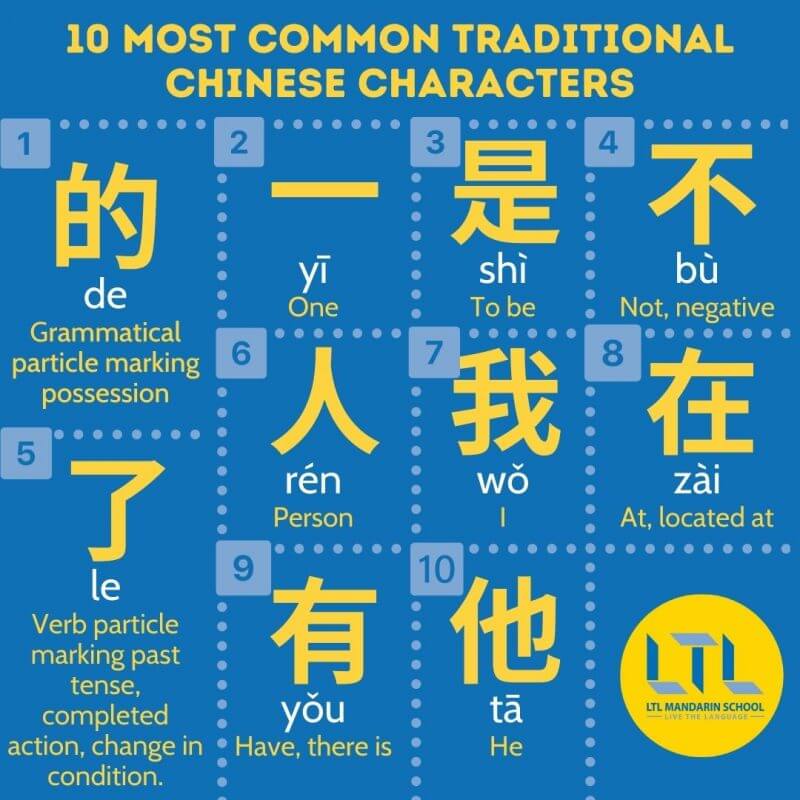
Traditional Chinese Characters List: 1-10
Now, if you’re also familiar with simplified Chinese you might actually notice that the top 10 most common traditional Chinese characters are written exactly the same as their simplified counterpart.
In fact, only around a quarter of the characters on this list differ from the simplified version.
The overlap between the two scripts is no accident. Simplified characters were introduced in the 1950s and 1960s, mainly through the 1956 simplification scheme and the 1964 general list, to make reading and writing quicker to learn and to raise literacy.
Characters that were already short, like 一, 人 and 不, didn’t need changing, so the reforms focused on characters with lots of strokes.
| Traditional Character | Simplified Character | Pinyin | English Translation |
|---|---|---|---|
| 的 | 的 | de | grammatical particle marking possession |
| 一 | 一 | yī | one |
| 是 | 是 | shì | to be |
| 不 | 不 | bù | not, negative |
| 了 | 了 | le | verb particle marking past tense, completed action, change in condition. |
| 人 | 人 | rén | person |
| 我 | 我 | wǒ | I |
| 在 | 在 | zài | at, located at |
| 有 | 有 | yǒu | have, there is |
| 他 | 他 | tā | he |
Traditional Chinese Characters List: 11-20
With our next 10 characters, we get our first variations from the simplified version.
| Traditional Character | Simplified Character | Pinyin | English Translation |
|---|---|---|---|
| 這 | 这 | zhè | this |
| 中 | 中 | zhōng | middle |
| 大 | 大 | dà | big |
| 來 | 来 | lái | come |
| 上 | 上 | shàng | above, on, over/last, previous |
| 國 | 国 | guó | country |
| 個 | 个 | gè | general quantifier |
| 到 | 到 | dào | to, towards, until, arrive |
| 說 | 说 | shuō | speak, say |
| 們 | 们 | men | pluralize nouns referring to people |
💡 How do Traditional characters differ from Simplified? Most changes follow a few patterns: a common component gets fewer strokes, a complex part is swapped for a simpler one, or two Traditional characters merge into one Simplified form. Once you spot the patterns, you can often guess one script from the other.
| Traditional | Simplified | Pinyin | What changed |
|---|---|---|---|
| 說 | 说 | shuō | Speech radical 言 becomes 讠 |
| 經 | 经 | jīng | Silk radical 糹 becomes 纟 |
| 們 | 们 | men | Door component 門 becomes 门 |
| 時 | 时 | shí | Sound component 寺 becomes 寸 |
| 過 | 过 | guò | Inner part 咼 becomes 寸 |
| 這 | 这 | zhè | Inner 言 becomes 文 |
| 國 | 国 | guó | Inner 或 becomes 玉 |
| 個 | 个 | gè | Replaced by a much shorter old form |
| 來 | 来 | lái | Same idea, fewer strokes |
A few Simplified characters stand for two different Traditional ones. 后 is used for both 後 (hòu, behind, after) and 后 (hòu, queen), and 里 for both 裡 (lǐ, inside) and 里 (lǐ, a unit of distance).
That’s why you can’t always convert from Simplified back to Traditional automatically.


Traditional Chinese Characters List: 21-30
| Traditional Character | Simplified Character | Pinyin | English Translation |
|---|---|---|---|
| 為 | 为 | wèi | in order to, for the purpose of… |
| 子 | 子 | zǐ | child |
| 和 | 和 | hé | together, with |
| 你 | 你 | nǐ | you |
| 地 | 地 | dì | earth, ground, place |
| 出 | 出 | chū | go out, come out |
| 道 | 道 | dào | way, path, way |
| 也 | 也 | yě | also, as well |
| 時 | 时 | shí | time period, season |
| 年 | 年 | nián | year |

Traditional Chinese Characters List: 31-40
| Traditional Character | Simplified Character | Pinyin | English Translation |
|---|---|---|---|
| 得 | 得 | de | to have to / adverbial particle |
| 就 | 就 | jiù | just, simply, right away |
| 那 | 那 | nà | that |
| 要 | 要 | yào | want, will do, need, important |
| 下 | 下 | xià | below, under, down / next |
| 以 | 以 | yǐ | because of, in order to / according to |
| 生 | 生 | shēng | give birth, life |
| 會 | 会 | huì | can, able, meet, party, society |
| 自 | 自 | zì | from, self |
| 著 | 着 | zhe | verb particle marking a progressive aspect (e.g. -ing) |


Traditional Chinese Characters List: 41-50
| Traditional Character | Simplified Character | Pinyin | English Translation |
|---|---|---|---|
| 去 | 去 | qù | go, leave, depart |
| 之 | 之 | zhī | subordinator, go, leave for |
| 過 | 过 | guò | pass, cross, exceed |
| 家 | 家 | jiā | home, family |
| 學 | 学 | xué | study, learn |
| 對 | 对 | duì | correct, mutual, pair |
| 可 | 可 | kě | ~able, may, can |
| 她 | 她 | tā | she |
| 裡 | 里 | lǐ | neighborhood, half kilometer |
| 后 | 后 | hòu | queen |


DOWNLOAD OUR FREE EBOOK
Looking for reliable tools to boost your Mandarin? We’ve gathered our favourite websites, extensions, and learning platforms into one handy ebook, completely free! It’s perfect for beginners or anyone looking to refresh their skills.
👉 Get your free Mandarin Resource Pack and take your studies to the next level.
Traditional Chinese Characters List: 51-60
Great, you’ve made it halfway already!!
Just another 50 to go and you’ll be one step closer to your Chinese learning goals!
| Traditional Character | Simplified Character | Pinyin | English Translation |
|---|---|---|---|
| 小 | 小 | xiǎo | small |
| 麼 | 么 | me/mo | interrogative suffix |
| 心 | 心 | xīn | heart |
| 多 | 多 | duō | many, much, more |
| 天 | 天 | tiān | sky, heaven, god, day |
| 而 | 而 | ér | and, furthermore |
| 能 | 能 | néng | can, be able |
| 好 | 好 | hǎo | good |
| 都 | 都 | dōu | all |
| 然 | 然 | rán | correct, so, like that |

Traditional Chinese Characters List: 61-70
| Traditional Character | Simplified Character | Pinyin | English Translation |
|---|---|---|---|
| 沒 | 沒 | méi | haven’t, there isn’t, no |
| 日 | 日 | rì | sun |
| 于 | 于 | yú | in, at, for, to, from, by, than |
| 起 | 起 | qǐ | rise, start |
| 還 | 还 | hái | still, yet |
| 發 | 发 | fā | deliver, develop, expand |
| 成 | 成 | chéng | accomplish, succeed / to become |
| 事 | 事 | shì | matter, thing, event, accident |
| 只 | 只 | zhǐ | only, just |
| 作 | 作 | zuò | do, make |


Traditional Chinese Characters List: 71-80
| Traditional Character | Simplified Character | Pinyin | English Translation |
|---|---|---|---|
| 當 | 当 | dāng | serve as, act as |
| 想 | 想 | xiǎng | think, feel, want |
| 看 | 看 | kàn | see, look at |
| 文 | 文 | wén | language, literature |
| 無 | 无 | wú | without, have not |
| 開 | 开 | kāi | open |
| 手 | 手 | shǒu | hand |
| 十 | 十 | shí | ten |
| 用 | 用 | yòng | use |
| 主 | 主 | zhǔ | lord, master, live |

You might have noticed we’ve already had a couple of numbers included in this list of most common Traditional Chinese characters.
Learning how to recognise and write numbers in Chinese is also a really good thing to learn and get your head around early on.

Traditional Chinese Characters List: 81-90
| Traditional Character | Simplified Character | Pinyin | English Translation |
|---|---|---|---|
| 行 | 行 | xíng | go, OK |
| 方 | 方 | fāng | side |
| 又 | 又 | yòu | again, both… and… |
| 如 | 如 | rú | like, as, as if |
| 前 | 前 | qián | in front, previous, first, former |
| 所 | 所 | suǒ | place |
| 本 | 本 | běn | basis, origin, edition |
| 見 | 见 | jiàn | appear to be, meet with |
| 經 | 经 | jīng | longitude |
| 頭 | 头 | tóu | head, top, first |


Traditional Chinese Characters List: 91-100
| Traditional Character | Simplified Character | Pinyin | English Translation |
|---|---|---|---|
| 面 | 面 | miàn | face, surface |
| 公 | 公 | gōng | public, official |
| 同 | 同 | tóng | same |
| 三 | 三 | sān | three |
| 已 | 已 | yǐ | stop, end |
| 老 | 老 | lǎo | old |
| 從 | 从 | cóng | from, through |
| 動 | 动 | dòng | move |
| 兩 | 两 | liǎng | two |
| 長 | 长 | cháng | long, length |


And there you have it, the 100 most common Traditional Chinese Characters full list!
Once you’ve learnt these you’ll start to recognise them everywhere, so it’s worthwhile to learn them to build a solid foundation.
How Traditional Chinese Characters Work || Types, Radicals and Stroke Order
Now that you’ve met the top 100, it helps to know how characters are built.
Once you can see the parts, a new character stops being a random tangle of lines and becomes something you can take apart and remember.
The four main types of Chinese characters
Classical scholars sorted characters into six categories, but four cover almost everything you’ll meet as a learner. You’ve already seen examples of each in our list.
| Character | Pinyin | Meaning | Type | How it’s built |
|---|---|---|---|---|
| 人 | rén | person | Pictograph | A drawing of a person walking |
| 日 | rì | sun | Pictograph | Once a circle with a dot in it |
| 上 | shàng | above | Simple ideogram | A mark above a line |
| 本 | běn | root, origin | Simple ideogram | A tree 木 with a stroke marking the root |
| 好 | hǎo | good | Compound ideogram | Woman 女 plus child 子 |
| 看 | kàn | look | Compound ideogram | A hand 手 shading an eye 目 |
| 們 | men | plural marker | Phono-semantic compound | Person 亻 for meaning, 門 (mén) for sound |
| 經 | jīng | pass through | Phono-semantic compound | Silk 糹 for meaning, 巠 (jīng) for sound |
Phono-semantic compounds, which pair a meaning component with a sound component, are by far the biggest group, making up the large majority of characters.
That’s good news: one part hints at the meaning and the other at the sound.
The 214 Kangxi radicals
A radical (部首 bùshǒu) is the component that dictionaries use to file a character, and it often hints at meaning. The standard set of 214 radicals comes from the Kangxi Dictionary of 1716, and Traditional character dictionaries in Taipei still sort characters this way.
| Radical | Pinyin | Meaning | Examples from the list |
|---|---|---|---|
| 亻(人) | rén | person | 他, 你, 們, 作 |
| 辶 | chuò | walking, movement | 這, 道, 過, 還 |
| 心 | xīn | heart, feelings | 心, 想 |
| 女 | nǚ | woman | 她, 好, 如 |
| 口 | kǒu | mouth | 和, 可 |
| 言 | yán | speech | 說 |
| 糹 | mì | silk, thread | 經 |
Learning the 50 or so most common radicals early pays off fast, because they keep turning up in new characters.
Stroke order basics
Stroke order isn’t only for calligraphers.
It makes your handwriting readable and helps you remember characters, and dictionary apps that let you draw a character to look it up rely on it.
- Top before bottom: 三
- Left before right: 你
- Horizontal before vertical: 十
- Middle before the two sides: 小
- Outside frame before inside, then close the frame last: 國
- Small dots and finishing touches often come last: 我
TIP💡 Write each new character five or six times while saying its pinyin out loud. Hand, eye and ear together beat silent staring every time.
How Many Traditional Chinese Characters Do You Need? || Official Lists and Exam Levels
Is there a complete list of every Traditional character?
Not really. Chinese writing has grown over thousands of years, so no single closed list holds every character.
The 1716 Kangxi Dictionary contains around 47,000 characters, and the Taiwan Ministry of Education’s dictionary of variant characters catalogues over 100,000 forms, most of them rare or historical.
For learners, what matters is the modern standard. Taiwan’s Ministry of Education sets out 4,808 commonly used characters in its Chart of Standard Forms of Common National Characters (常用國字標準字體表). That chart fixes the correct Traditional shape of each one for schools and publishing, so it’s the benchmark when you want to check that you’re writing a character the standard way.
Character targets for TOCFL and HSK
Here’s how the 100 characters on this page fit into the bigger picture. The TOCFL (Test of Chinese as a Foreign Language) is Taiwan’s official Mandarin proficiency exam, and the TBCL (Taiwan Benchmarks for the Chinese Language) is the framework that sets which characters and words belong to each level.
| Benchmark | Characters | What it means for you |
|---|---|---|
| This list | 100 | Recognise a big share of the characters in any everyday text |
| TBCL Level 1 (the framework behind TOCFL) | 246 | Simple words about yourself and daily life |
| TBCL Levels 1-2 | 504 | Short sentences on familiar topics |
| TBCL Levels 1-3 | about 800 | Short conversations at school, work and around town |
| TBCL Levels 1-7 | 3,100 | The full framework, alongside 14,425 words |
| New HSK Level 1 | 246 to recognise | Entry level of the 9-level HSK |
| New HSK Levels 1-9 | 3,088 to recognise | Advanced level, with 1,200 to write by hand |
| Taiwan MOE common characters | 4,808 | The official standard for schools |
TOCFL score reports have shown your TBCL level since August 2021. If you’re studying in Taipei, TOCFL is the exam most learners take, and it can be sat in Traditional characters.
Characters vs words: how many words are there in Mandarin?
A character (字 zì) and a word (詞 cí) aren’t the same thing. Many words combine two characters you already know from this list, like 學生 (xuésheng, student) or 大學 (dàxué, university).
There’s no single fixed number of words in Mandarin. To give you a sense of scale, the TBCL builds 14,425 words from its 3,100 characters, and the new HSK lists about 11,000 words, while large dictionaries hold far more. Every character you learn unlocks several words at once.
How to Learn These Characters || Themes and Memory Tips
A frequency list tells you what to learn first.
Grouping characters by theme helps you remember them, because your brain stores them as a set.
Grouped by theme
| Traditional | Pinyin | Meaning | Theme |
|---|---|---|---|
| 一 | yī | one | Numbers |
| 兩 | liǎng | two (of something) | Numbers |
| 三 | sān | three | Numbers |
| 十 | shí | ten | Numbers |
| 我 | wǒ | I | People |
| 你 | nǐ | you | People |
| 他 | tā | he | People |
| 她 | tā | she | People |
| 們 | men | plural for people | People |
| 家 | jiā | home, family | People |
| 上 | shàng | above, on | Directions |
| 下 | xià | below, under | Directions |
| 中 | zhōng | middle | Directions |
| 前 | qián | in front | Directions |
| 後 | hòu | behind, after | Directions |
| 裡 | lǐ | inside | Directions |
| 年 | nián | year | Time |
| 天 | tiān | day, sky | Time |
| 日 | rì | sun, day | Time |
| 時 | shí | time | Time |
Memory tips that actually work
- Use spaced repetition. Apps like Pleco and Skritter show you each character just before you’d forget it, which beats rereading a list.
- Learn characters inside words, not alone. 學 sticks better as 學生 (xuésheng, student) and 大學 (dàxué, university).
- Write by hand on grid paper (田字格 tiánzìgé) using the stroke order rules above.
- Break new characters into radicals and parts, then make a mini story: 好 is a woman 女 with her child 子, and that’s good.
- Read the city around you. In Taipei, you’ll see 大, 中, 上 and 下 on MRT signs and shopfronts from day one.
💡 How do you type Traditional characters? You have three main options. Pinyin input lets you type the sound in Roman letters and pick the character from a list, so it’s the quickest way in. Zhuyin input uses the ㄅㄆㄇㄈ symbols and is the default keyboard layout on many devices in Taipei. Cangjie (倉頡 Cāngjié) works differently: you break a character into its parts and press the matching keys. It takes practice, but it works without knowing the pronunciation.
TIP💡 Aim for 5 to 10 new characters a day and review the old ones before adding more. Steady beats heroic when it comes to characters.
Traditional Chinese Characters Quiz

Chinese Characters Posters
Like having characters in sight while you study?
Our Chinese character posters are made to print and stick by your desk, so you review without even trying.
Traditional Chinese Characters List || FAQs
What is the most common Traditional Chinese character?
The most common traditional Chinese character is 的 (de) which is a grammatical particle.
What are the 10 most common Traditional Chinese characters?
The 10 most common traditional Chinese characters are 的,一,是,不,了,人,我,在,有,他。
How long does it take to learn the 100 most common Traditional Chinese characters?
At 5 to 10 characters a day, most learners can recognise the 100 most common Traditional characters in about 2 to 4 weeks. Writing them from memory takes longer, so give yourself extra time for that.
In Chinese classes you’ll meet these characters in every lesson, which speeds things up a lot.
Are all simplified and traditional character different?
Only around a quarter of the characters on this list differ from the simplified version.
Where is best to learn Traditional Chinese?
Taipei is a great choice. Traditional characters are on every street sign, menu and MRT map, and Mandarin is the everyday language of the city, while daily life in Hong Kong runs mainly in Cantonese.
At LTL Taipei, our courses are taught in Traditional characters, so this list turns into daily reading practice. Find out how to study Mandarin in Taipei.
What are the four main types of Chinese characters?
The four main types are pictographs, simple ideograms, compound ideograms and phono-semantic compounds.
Pictographs like 人 (person) began as drawings, simple ideograms like 上 (above) use marks to show an idea, and compound ideograms like 好 (good) combine two meanings.
Phono-semantic compounds such as 們 pair a meaning part with a sound part, and they make up the large majority of characters.
How many words are there in Chinese Mandarin?
There is no single fixed number of words in Mandarin.
As a sense of scale, the TBCL framework behind the TOCFL builds 14,425 words from 3,100 characters, and the new HSK lists about 11,000 words.
Large dictionaries hold far more. Because many words combine two familiar characters, every character you learn unlocks several words at once.
What are Chinese character symbols?
Chinese characters (漢字 hànzì) are logographic symbols rather than letters. Each one stands for one syllable and usually one unit of meaning, so 人 (rén) is both the sound ‘ren’ and the idea ‘person’.
Many characters are built from smaller components called radicals, which often hint at meaning or sound.
How to write Chinese “I love you”?
In Traditional Chinese, “I love you” is written 我愛你 (wǒ ài nǐ). 我 means I and 你 means you, and both appear in the list of the 100 most common characters.
In Simplified Chinese the middle character is written 爱, so the phrase becomes 我爱你, with the same pronunciation.
Want more from LTL?
If you wish to hear more from LTL Language School why not join our mailing list.
We give plenty of handy information on learning Chinese, useful apps to learn the language and everything going on at our LTL schools!
Sign up below and become part of our ever growing community!
BONUS | Want to study the local Taiwanese dialect known as Hokkien? We provide Hokkien classes in person and online.
⭐ Download our free ebook, your starter pack of essential Mandarin learning resources!






11 comments
I got the full 100%!!!! So hyped
Go on CJ!!
So many are the same, should I learn both?
Your choice Coleman, Simplified is always a good starting point but there's no harm trying to learn both as you go. Pleco will help you here.
😍😍
Every one right in the quiz
The boss!
Traditional are way more beautiful, just sayin
😃
How do you know the orientation of the symbols if not in a definable context? e.g. Makers Marks on the bottom of a cylindrical brass bowl? To me the symbols could be read from any of 4 positions.
[…] BONUS || Do you know the 100 most commonly used Chinese characters? Check them out here. […]